
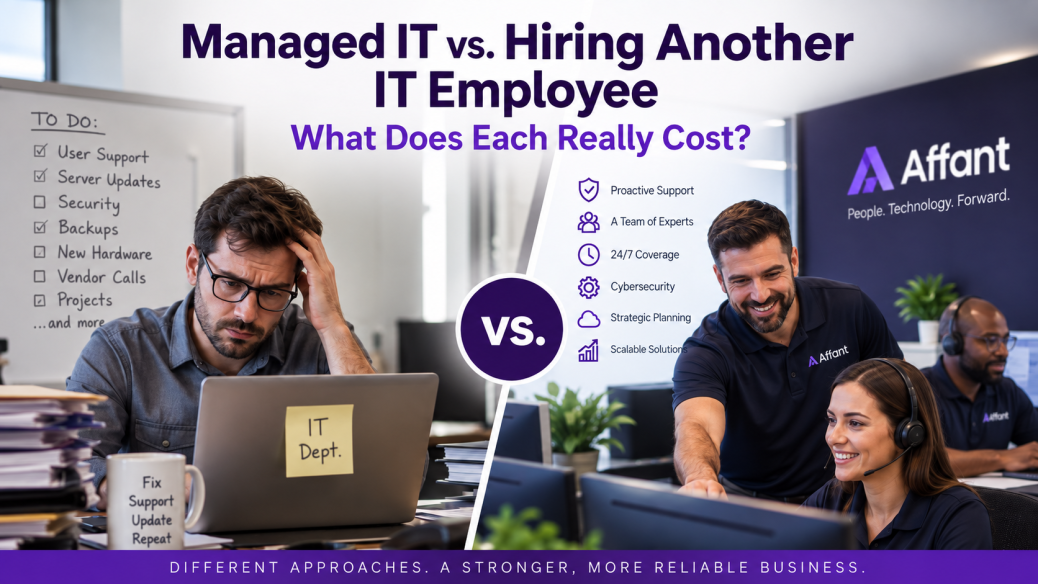
When a business starts feeling the strain of growing IT demands, one of the first questions is usually whether to hire another internal IT employee or bring in a managed IT services provider.
At first glance, the comparison can seem simple. One option has a salary attached to it. The other has a monthly service fee.
But the true cost of IT support goes well beyond either of those numbers.
Businesses need to consider coverage, expertise, software tools, cybersecurity, employee benefits, recruiting, training, time off, after-hours support, and the cost of problems that go unresolved because one person simply cannot be everywhere at once.
Understanding those differences can help determine which approach makes the most sense for your organization.
The True Cost of Hiring an IT Employee
The most obvious cost of an internal IT employee is salary, but that is only the starting point.
Employers also have to account for payroll taxes, health insurance, retirement contributions, paid time off, recruiting expenses, equipment, training, certifications, and other benefits.
There is also the cost of the tools that person needs to do the job effectively.
Modern IT departments rely on remote monitoring platforms, endpoint management software, cybersecurity tools, backup systems, documentation platforms, ticketing systems, network monitoring, and other specialized technologies.
When a company hires an employee directly, many of those systems still need to be purchased separately.
The result is that the real annual cost of adding an IT employee can be significantly higher than the salary listed in the job posting.
One Employee Cannot Cover Every Area of IT
Another challenge is specialization.
Business technology has become too broad for most individual IT professionals to be experts in everything.
A company may need help with Microsoft 365, networking, cybersecurity, cloud infrastructure, backups, servers, compliance, endpoint management, vendor coordination, and employee support.
Those are very different disciplines.
An excellent network administrator may not be a cybersecurity specialist. Someone who is great at user support may not have deep experience with cloud architecture or disaster recovery.
Larger companies solve this problem by building IT departments with multiple specialists.
For small and midsized businesses, however, hiring an entire team is often unrealistic.
A managed IT provider gives businesses access to a broader group of professionals without requiring the company to hire each role individually.
What Happens When Your IT Person Is Unavailable?
Coverage is another cost that is easy to overlook.
Employees take vacations. They get sick. They attend training. They have days when they are already working on a major project while another issue appears.
If a company depends heavily on one or two internal IT employees, their availability can become a business risk.
A server problem, internet outage, cybersecurity incident, or Microsoft 365 issue does not necessarily wait until the IT person returns to the office.
Managed IT services are built around team coverage.
Instead of relying on a single individual, businesses have access to a support organization with multiple technicians who can respond when an issue occurs.
That redundancy becomes especially important as a company grows and downtime becomes more expensive.
Managed IT Includes More Than Help Desk Support
Managed IT is sometimes compared directly to the cost of hiring a help desk employee, but the services provided can extend much further.
A managed IT provider may handle monitoring, patching, backups, cybersecurity, network management, Microsoft 365 administration, vendor coordination, employee onboarding and offboarding, technology planning, and ongoing maintenance.
Those responsibilities might otherwise be divided among several internal employees.
The value is not simply having someone available when a computer stops working.
The larger goal is preventing problems, maintaining the environment, and giving the business access to the technical resources it needs without having to build those capabilities internally.
The Cost of Recruiting and Retaining IT Talent
Hiring also takes time.
Companies need to write job descriptions, review applications, interview candidates, negotiate compensation, onboard the employee, and allow time for that person to become familiar with the environment.
If the employee leaves, the process starts again.
IT turnover can be particularly difficult because technical knowledge often becomes concentrated in the people managing the systems.
Documentation may be incomplete, passwords may need to be transferred, projects may be left unfinished, and other employees may not fully understand how certain systems were configured.
A managed IT relationship can provide greater continuity because knowledge is shared across a team and documented as part of the support process.
Internal IT and Managed IT Do Not Have to Be Either-Or
For many organizations, the best solution is not choosing between internal IT and managed IT.
It is using both.
An internal IT employee may understand the company’s people, workflows, and business applications extremely well.
A managed IT provider can support that employee with additional expertise, tools, monitoring, project resources, and additional coverage.
This approach is often called co-managed IT.
It can be particularly useful for businesses that already have a capable IT person but are asking that employee to handle more than one person realistically should.
Instead of replacing internal IT, the managed provider becomes an extension of the existing team.
Which Option Is More Cost-Effective?
There is no universal answer.
Hiring another IT employee may make sense for an organization that needs a dedicated resource focused entirely on internal projects and has enough IT infrastructure to support a larger department.
Managed IT may make more sense when a business needs broader expertise, predictable support costs, additional coverage, cybersecurity resources, and access to a full technical team.
The important part is comparing the complete cost of each option rather than comparing a monthly managed services invoice to an employee’s base salary.
Businesses should consider:
- Salary and benefits
- Recruiting and onboarding
- Training and certifications
- IT management software and security tools
- Vacation and sick-day coverage
- After-hours support
- Cybersecurity expertise
- Backup and disaster recovery
- Network and cloud expertise
- Ongoing documentation
- Strategic IT planning
- The cost of downtime when support is unavailable
Once those costs are included, the difference between the two options often looks very different.
Build an IT Team That Fits Your Business
The goal should not be to have the largest IT department.
It should be to have the right resources available when the business needs them.
Affant provides managed and co-managed IT services for businesses that need reliable support, proactive technology management, and access to a live team of experienced IT professionals.
Whether your company is considering hiring another IT employee or looking for additional support for an existing IT team, Affant can help you evaluate your current environment and determine the most practical way to support your business.
Contact Affant to learn more about building an IT support model that fits your organization.