
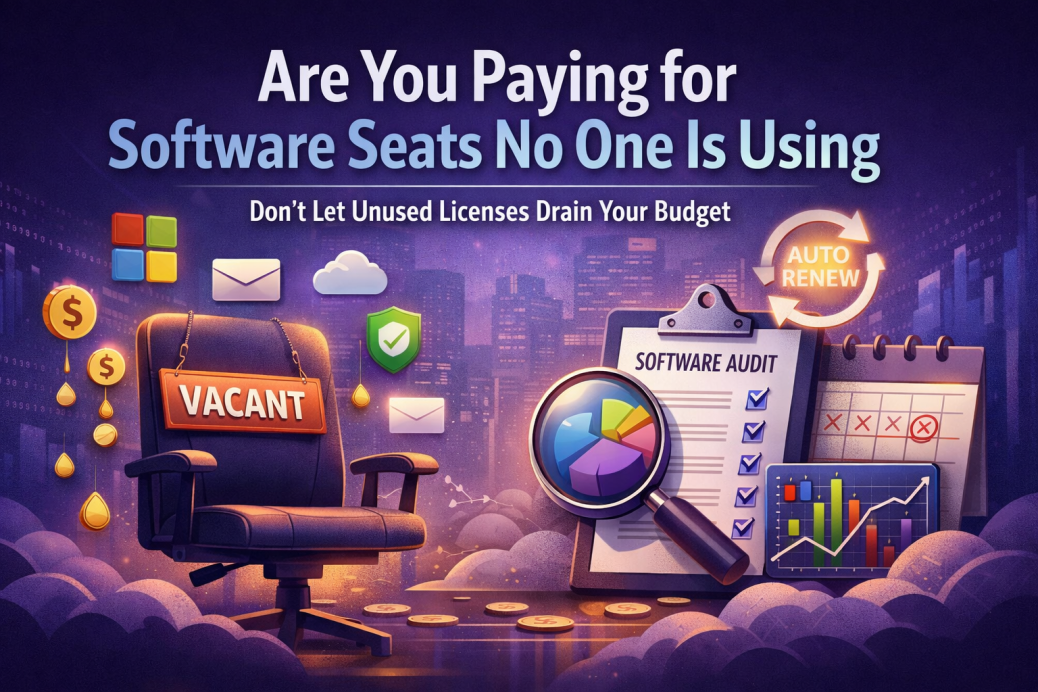
The Hidden Cost of Auto Renewing Software Subscriptions
For many growing businesses in Orange County and throughout Southern California, technology expenses have become one of the largest operational line items outside of payroll.
Yet unlike payroll, software spending is rarely reviewed with the same discipline.
Annual subscriptions from providers such as Microsoft and other SaaS vendors quietly renew in the background. What begins as a strategic investment in productivity, collaboration, and security gradually evolves into recurring spend attached to former employees, over provisioned license tiers, and tools that no longer align with how the business operates.
There is no alarm bell when this happens.
Just a slow erosion of margin.
For small and mid sized businesses, especially those with 20 to 200 employees, that erosion can translate into tens of thousands of dollars over time.
How Overspending Happens in Well Run Companies
This issue does not stem from poor leadership. In fact, it often appears in organizations that are moving quickly and scaling responsibly.
New hires are onboarded efficiently. Access is provisioned immediately. Security tools are layered in. Premium licenses are assigned to ensure no one lacks capability. From a productivity standpoint, this is good management.
Where problems begin is in optimization.
Employees leave, but their licenses remain active for weeks or months. Departments temporarily expand during busy seasons but never fully scale back. Managers upgrade users “just in case,” and those upgrades quietly become permanent. IT assumes finance is tracking renewals. Finance assumes IT is managing usage.
Without a formal review structure, no one is intentionally wasting money.
But waste accumulates anyway.
Why Annual Contracts Increase Financial Risk
Annual subscription agreements are designed to encourage long term commitment. Vendors offer discounted pricing in exchange for locking in usage for twelve months or longer.
On paper, it looks fiscally responsible.
In reality, annual contracts remove flexibility at the exact moment when businesses need it most. Headcount shifts. Market conditions change. Strategic priorities evolve. Mergers, acquisitions, or reorganizations alter tool requirements.
When licenses are locked into annual terms without deliberate review, organizations end up paying for yesterday’s structure with today’s budget.
The issue is not the contract itself.
The issue is automatic renewal without executive oversight.
Microsoft 365 Is Frequently the Largest Exposure
Across Orange County businesses, Microsoft 365 is often the single largest recurring software expense. Because Microsoft 365 integrates email, collaboration, cloud storage, security, and device management, even minor misalignment in licensing strategy has amplified cost impact.
We routinely find:
Premium enterprise licenses assigned to users who only require email and basic document access.
Inactive accounts that have not logged in for months but remain fully licensed.
Duplicated or legacy accounts left over from staffing changes.
Security add ons layered without reevaluating existing coverage.
Individually, each scenario appears insignificant.
Collectively, they can represent thousands to tens of thousands of dollars annually.
Executive Alignment Is the Real Solution
The most financially disciplined organizations treat software licensing as a strategic asset class, not a passive utility.
They implement quarterly usage reviews.
They align IT reporting with finance oversight.
They calendar renewal dates well in advance.
They downgrade or consolidate proactively.
This level of discipline transforms technology from a cost center into a managed investment.
For leadership teams, especially CEOs, CFOs, and operations directors, this visibility creates stronger forecasting accuracy and tighter budget control heading into each fiscal year.
How Affant Supports Orange County Businesses
Affant provides managed IT services and strategic technology oversight for small and mid sized businesses across Orange County and Southern California.
As part of our engagement, we conduct structured software and subscription audits that analyze:
Active user counts
License tiers and upgrade patterns
Login activity and dormant accounts
Contract terms and renewal timelines
Redundant or overlapping SaaS tools
We do not simply reduce cost. We align technology spending with actual operational demand.
In many cases, the savings identified during one audit offset a meaningful portion of our managed IT investment. More importantly, our clients regain control over renewals, budgeting, and long term IT planning.
Before Your Next Renewal Cycle
If your organization has not performed a structured subscription review within the past six months, there is a strong probability that inefficiencies exist.
Before your next annual renewal processes automatically, schedule a strategic review.
Small recurring charges rarely attract attention.
But compounded over time, they materially impact profitability.
Consultation Offer
Affant is offering a complimentary Software and License Efficiency Review for qualified Orange County businesses.
During this consultation, we will:
Evaluate your Microsoft 365 licensing structure
Identify unused or downgradable seats
Highlight renewal risks and contract exposure
Provide a clear cost optimization roadmap
If you would like greater financial visibility, stronger IT governance, and predictable technology budgeting, we invite you to schedule a consultation with our team.
Technology should support your margins.
Not quietly erode them.