
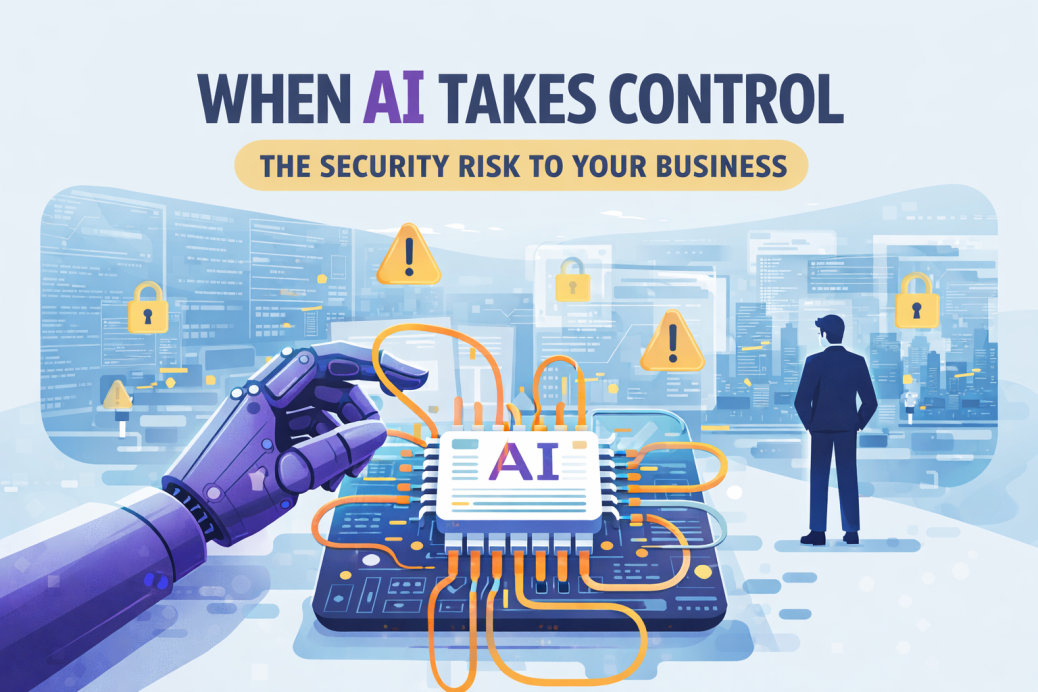
AI has quietly moved from being a tool to being something much closer to an operator.
A year ago, most businesses used AI for writing emails, summarizing notes, or answering quick questions. Today, it is being connected directly into core systems. It can read files, write code, interact with APIs, deploy updates, monitor environments, and in some cases, execute commands on machines.
That shift is where things get complicated.
Because the more useful AI becomes, the more access it needs. And the more access it has, the closer it gets to behaving like a system administrator.
That is not inherently bad. But it is something most businesses have not fully adjusted to yet.
The Shift from Tool to System Actor
Traditional software does exactly what it is programmed to do. AI does not.
Modern AI systems are designed to interpret instructions, adapt to context, and make decisions about how to complete a task. When those systems are connected to infrastructure, they are no longer just generating output. They are taking action.
This includes things like:
- Executing scripts on servers or endpoints
- Modifying system configurations
- Managing cloud resources
- Interacting with internal databases
- Triggering automated workflows across multiple platforms
At that point, the AI is no longer sitting outside your environment. It is operating inside it.
And that is where the risk starts to change.
The CPU-Level Conversation (And Why It Matters)
When people talk about AI risk, they often jump straight to extreme scenarios. In reality, the more immediate concern is much simpler and much more practical.
It is about control.
Many AI-powered tools are now capable of interacting with processes running on machines. Whether through local agents, remote management tools, or integrations with operating systems, they can influence how workloads are executed and how systems behave.
This does not mean AI is “taking over CPUs” in a dramatic sense. It means it is being given the ability to:
- Start and stop processes
- Allocate resources through automation
- Execute commands at the system level
- Interface with scripts that directly affect machine behavior
If those capabilities are exposed without strict controls, they become a new attack surface.
Not because the AI is malicious, but because anything with that level of access becomes valuable to someone who is.
The Real Risk Isn’t AI — It’s Access
The biggest misconception right now is that AI itself is the threat.
It is not.
The threat is what happens when AI is given broad, persistent, and poorly monitored access to critical systems.
Most businesses do not think twice about connecting an AI tool to:
- Email and calendar systems
- File storage and document repositories
- CRM and financial platforms
- Cloud infrastructure dashboards
- Internal tools and scripts
Individually, these connections feel harmless. Together, they create a highly privileged layer that sits across the entire business.
If something goes wrong at that layer, the impact is not isolated. It is widespread.
Indirect Attacks: The New Entry Point
Traditional cybersecurity is built around blocking unauthorized access. Firewalls, endpoint protection, and authentication systems are all designed to keep attackers out.
But AI introduces a different kind of problem.
What if the “attacker” does not need to break in at all?
If an AI system already has trusted access, the goal shifts from intrusion to influence.
This is where things like prompt injection and data manipulation come into play. Instead of hacking the system directly, a bad actor can feed it inputs that cause it to behave in unintended ways.
For example:
- An AI connected to file systems could be tricked into exposing sensitive documents
- An AI managing scripts could be influenced to execute unsafe commands
- An AI integrated with APIs could unintentionally change configurations or permissions
The system is doing exactly what it was designed to do. It is just responding to the wrong inputs.
And because the activity is coming from a trusted system, it often bypasses traditional security controls.
Over-Permissioning: The Quiet Problem Nobody Tracks
In most environments, permissions accumulate over time.
A tool is given access for a specific purpose. Later, it is expanded slightly to support another workflow. Then another integration is added. Eventually, no one is entirely sure what the full scope of access looks like anymore.
AI accelerates this problem.
Because these tools are designed to be flexible, they often request broad permissions upfront. It makes setup easier and functionality smoother. But it also creates a situation where the AI has far more access than it realistically needs.
This is known as over-permissioning, and it is one of the most common causes of security exposure today.
The issue is not obvious day to day. Everything works. Nothing breaks. But underneath, there is a growing gap between what the system can do and what it should be allowed to do.
Automation Without Boundaries
Another layer to this is automation.
AI is often paired with automation platforms to streamline operations. Tasks that used to require multiple steps can now happen instantly. That is a huge advantage for productivity.
But automation removes friction.
And friction is often what prevents small mistakes from becoming big ones.
If an AI system misinterprets a request and triggers an automated workflow, it can:
- Push incorrect changes across multiple systems
- Modify configurations at scale
- Distribute data to unintended locations
- Trigger cascading actions that are difficult to reverse
In a traditional setup, a human might catch the issue before it spreads. In an automated environment, everything happens too quickly.
Why SMBs Are More Exposed Than They Think
Large organizations are starting to build internal policies around AI usage. They are auditing integrations, restricting access, and creating oversight mechanisms.
Small and mid-sized businesses are moving faster, but often without those controls in place.
That is not because they are careless. It is because they are focused on growth and efficiency, and AI delivers both.
The problem is that security rarely breaks immediately. It weakens gradually.
A new tool gets connected. Another integration is added. Permissions expand. Visibility decreases. Over time, the environment becomes more complex and less controlled.
By the time an issue surfaces, it is usually not small.
What Smart Companies Are Doing Differently
The businesses that are getting ahead of this are not avoiding AI. They are treating it like any other critical system.
They are asking practical questions:
- What exactly does this tool have access to?
- Does it need that level of access to function?
- What happens if it behaves unexpectedly?
- Can we monitor and audit what it is doing?
They are implementing basic but effective controls:
- Limiting permissions to the minimum required
- Segmenting systems so one tool cannot access everything
- Reviewing API connections regularly
- Monitoring activity and logging system changes
- Keeping a clear boundary between automation and authority
None of this slows down innovation. It just keeps it contained.
Where Affant Comes In
Most businesses do not have the time to map out every integration, permission set, and automation path across their environment.
That is where things start to slip.
At Affant, we work with businesses to make sure modern tools, including AI, are implemented with structure. That means understanding how these systems connect, where they have access, and how to control that access without breaking functionality.
It is not about restricting progress. It is about removing blind spots.
You still get the efficiency. You still get the automation. You just do not inherit unnecessary risk along the way.