
Most businesses do not start with a formal IT strategy.
They start with what works.
You buy a few computers, set up internet, sign up for email, and figure things out as you go. Someone on the team becomes the unofficial tech person, and when something breaks, it gets handled.
In the early stages, this approach is completely reasonable.
But as the business grows, the cracks begin to show.
Systems become harder to manage. Issues happen more often. Small problems start turning into real interruptions. And eventually, you start to wonder if your current setup is still supporting your business or quietly holding it back.
If you are asking that question, here are seven clear signs that you have outgrown DIY IT.
1. The Same Problems Keep Coming Back
One of the first signs is repetition.
You fix the WiFi, and a week later it drops again. A computer slows down, gets patched up, then slows down again. Login issues get resolved, only to resurface with another employee.
Nothing ever fully breaks, but nothing ever fully works either.
This is what reactive IT looks like. Problems are handled in the moment, but the root cause is never addressed. Over time, these recurring issues create a steady drag on productivity that most businesses begin to accept as normal.
It is not normal. It is a sign your systems are not being properly managed.
2. IT Issues Are Starting to Interrupt Real Work
There is a point where IT stops being background noise and starts affecting your day.
Employees are waiting on fixes. Files are not accessible when needed. Systems freeze in the middle of important tasks. What used to be minor inconveniences now delay real work.
In many cases, the business owner ends up stepping in to help. Time that should be spent on growth, sales, or client relationships gets pulled into troubleshooting.
That shift is important. When IT begins to interfere with revenue generating work, it is no longer just a technical issue. It is a business problem.
3. You Are Not Fully Sure How Secure You Are
Security is one of the biggest gaps in DIY IT, and often the least visible.
Most businesses assume they are probably fine, but cannot confidently answer basic questions. Are backups actually working and tested? Are systems consistently updated? Do employees have the right access controls? Would you know if something was compromised?
The reality is that small businesses are now common targets for cyberattacks. Not because they are high profile, but because they are easier to get into.
The risk is not just the attack itself. It is the uncertainty. If something happened, would you be able to recover quickly, or would it turn into a major disruption?
4. Your Technology Has Grown Without a Clear Plan
Over time, DIY IT tends to grow in pieces.
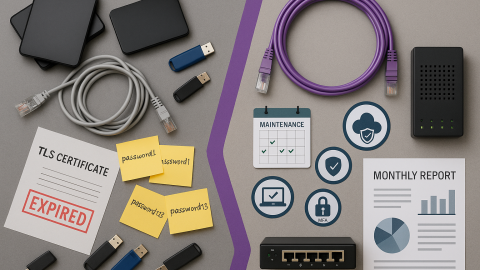
Different computers get purchased at different times. Software is added as needed. Tools overlap. Some systems talk to each other, others do not. Documentation is limited or nonexistent.
Nothing feels completely broken, but everything feels a little disorganized.
This lack of structure creates friction. New employees take longer to get set up. Troubleshooting becomes more difficult. Costs increase without a clear understanding of where the money is going.
Instead of supporting your business, your technology becomes something you work around.
5. Growth Is Making Things More Complicated
Growth is where many businesses realize their current IT setup is no longer enough.
Adding more employees increases the number of devices, accounts, and support requests. Systems that worked for a small team begin to slow down or break under more demand.
If you expand to another location or support remote work, the complexity increases even more.
Without a plan, growth does not just add opportunity. It adds stress to every part of your technology. What once felt simple becomes difficult to manage, and small issues begin to scale with the business.
6. Everything Depends on One Person
Many businesses rely on a single person to handle IT, even if that is not their official role.
It might be an employee who is good with computers, a freelancer you call when needed, or a contact who helps out occasionally.
This creates a fragile system.
If that person is unavailable, busy, or unable to solve a more complex issue, there is no backup plan. The entire business is exposed to delays or downtime.
A single point of failure in IT is one of the biggest risks a growing company can have, especially as operations become more dependent on technology.
7. Your IT Costs Feel Unpredictable
DIY IT often appears less expensive because there is no fixed monthly cost.
But the reality is different.
Costs show up unexpectedly. A system fails and needs to be replaced. An issue requires emergency support. Software renewals stack up. Downtime creates losses that are harder to measure but very real.
Instead of a consistent investment, IT becomes a series of unplanned expenses.
That unpredictability makes it difficult to budget and even harder to understand what you are actually spending over time.
So Do You Need an IT Company
If several of these situations feel familiar, the answer is likely yes.
Outgrowing DIY IT is not a failure. It is a natural step as your business becomes more complex and more reliant on technology.
The real risk is not making the transition. It is waiting too long and allowing small issues to turn into larger, more expensive problems.
What Changes When You Move to Managed IT
When IT is handled professionally, the experience is very different.
Problems are addressed before they interrupt your day. Systems are monitored and maintained consistently. Security is no longer a question mark. Your setup becomes something that supports your growth instead of reacting to it.
Just as important, your time is no longer tied up in technical issues.
You and your team can focus on running the business, knowing the systems behind it are being handled properly.
The Bottom Line
DIY IT works in the early stages because it is simple and flexible.
But as your business grows, that same approach can quietly introduce risk, inefficiency, and unnecessary cost.
If your systems are starting to feel like a source of stress instead of support, it is a sign that something needs to change.
The goal is not just to fix problems. It is to create an environment where your technology reliably supports everything your business is trying to do.
Let’s Take IT Off Your Plate
If you are starting to question whether your current setup is enough, that is the right time to look at your options.
Affant provides consistent, predictable IT support with real human help, proactive monitoring, and systems designed to scale with your business.
A simple assessment can show you where things stand today and where improvements can be made.
From there, you can decide what makes the most sense for your business moving forward.