
Most businesses don’t think much about IT support until something goes wrong.
Everything works. Employees are productive. Email is flowing. Customers are being served. Then suddenly, without warning, a critical system fails and the entire business comes to a halt. What seemed like a normal workday can quickly turn into a stressful situation that affects every department and every employee.
The reality is that IT emergencies happen to companies of every size. Hardware fails. Internet connections go down. Cybercriminals launch attacks. Cloud services experience outages. Employees accidentally delete critical data. When these situations occur, the difference between a minor disruption and a major business crisis often comes down to one thing: how quickly you can get the right people involved and begin taking corrective action.
The Server Goes Down at 8:15 AM
Imagine your employees arrive at work and can’t access company files.
Shared folders won’t open. Business applications won’t launch. Accounting can’t process invoices. Customer service representatives can’t access records. Everyone is standing around waiting for answers. Productivity slows to a crawl, and managers are left trying to explain the situation while critical tasks pile up.
This is one of the most common IT emergencies businesses face. Whether the cause is hardware failure, software corruption, or a security incident, the impact can be immediate and widespread across the organization.
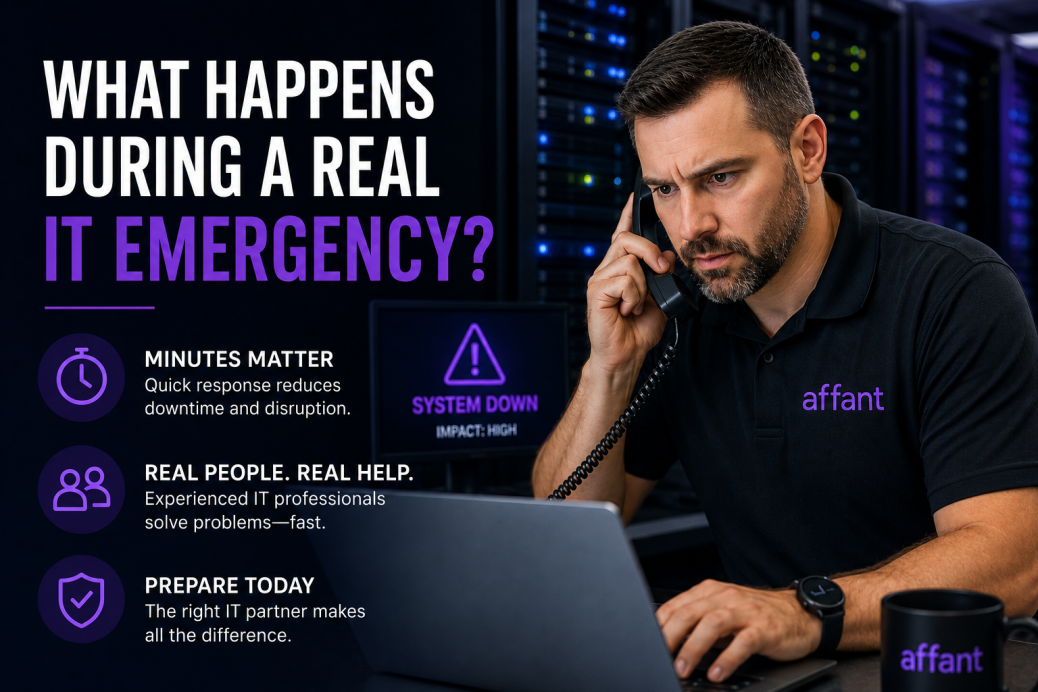
The first few minutes are critical. Is the server actually down? Is it a network issue? A storage failure? A ransomware attack? Something else entirely? Determining the root cause quickly is essential because every minute spent guessing can extend downtime and increase business disruption.
When a company relies on self-service troubleshooting, AI chatbots, or generic support centers, valuable time is often wasted trying to determine what happened. Employees may attempt fixes that don’t address the real issue, while leadership struggles to get accurate information about the situation.
A dedicated IT team can immediately begin diagnosing the problem, identify the root cause, and start recovery efforts. Instead of spending hours explaining the situation to multiple support representatives, businesses have direct access to people who already understand their environment and can take meaningful action right away.
The Internet Suddenly Stops Working
For many businesses, losing internet connectivity means losing the ability to operate.
VoIP phones stop functioning. Cloud applications become inaccessible. Remote employees can’t connect. Customer transactions may be interrupted. In today’s connected business environment, even a short internet outage can affect communication, sales, customer service, and internal operations.
Many business owners assume calling their internet provider is the solution. Unfortunately, that often leads to lengthy hold times and scripted troubleshooting. While the provider investigates, employees may remain idle and important business processes may be delayed.
An experienced IT team can quickly determine whether the issue originates with the provider, firewall, network equipment, cabling, or internal systems. In many cases, the problem can be identified and corrected before the ISP completes its own troubleshooting process. Having knowledgeable professionals involved early can significantly reduce downtime and restore productivity faster.
The Ransomware Nightmare
Few IT emergencies create more panic than ransomware.
An employee clicks a malicious link. Files become encrypted. Systems become inaccessible. A ransom note appears demanding payment. What begins as a single mistake can rapidly spread throughout an organization if not addressed immediately.
In these moments, every minute matters. The faster the response, the greater the chance of limiting damage and preserving critical business data.
The wrong response can make the situation significantly worse. Employees may unknowingly spread the infection. Critical evidence may be lost. Recovery efforts can become more difficult. Decisions made during the first stages of an attack often have long-term consequences for recovery and business continuity.
Organizations that already have an experienced IT team in place can immediately isolate affected systems, stop further spread, evaluate backups, begin recovery procedures, and coordinate communication with management. They can also help ensure that recovery efforts follow established best practices and security guidelines.
Businesses without professional support often find themselves scrambling to locate help while the attack continues to cause damage. Unfortunately, valuable time is lost during the period when rapid action is most important.
The Cloud Isn’t Always Available
Many organizations assume moving to cloud platforms eliminates downtime.
While cloud services are generally reliable, outages still happen. Even the largest technology providers occasionally experience disruptions that affect thousands or even millions of users.
Microsoft 365 disruptions, internet provider failures, DNS issues, authentication problems, and third-party service outages can all prevent employees from accessing critical business tools. When these services become unavailable, organizations may find themselves unable to communicate, collaborate, or complete essential tasks.
When cloud services fail, businesses still need someone who can determine what’s happening, identify temporary workarounds, communicate with staff, and help restore operations as quickly as possible. Clear communication and effective planning can help reduce confusion and keep teams productive during an outage.
Technology may be hosted elsewhere, but responsibility for keeping your business productive doesn’t disappear. Organizations still need knowledgeable professionals who can manage disruptions and help employees navigate unexpected challenges.
Why Human Support Matters During Emergencies
When a business is facing an IT emergency, technology knowledge is only part of the solution.
Equally important is having someone who can make decisions, coordinate efforts, communicate clearly, and take ownership of the situation. Technical expertise is valuable, but leadership and problem-solving skills are often what keep an incident from becoming a larger crisis.
This is where real-person support becomes extremely valuable. Having direct access to experienced professionals provides reassurance and allows businesses to focus on maintaining operations while technical issues are addressed.
AI tools, automated chat systems, and large overseas call centers can be useful for answering routine questions. However, during an actual crisis, businesses need more than troubleshooting scripts. They need support that is responsive, informed, and capable of adapting to unique circumstances.
They need experienced professionals who can assess the situation, prioritize actions, and guide recovery efforts. These individuals can provide practical recommendations, coordinate resources, and ensure that everyone involved understands the next steps.
A chatbot cannot physically visit an office if network equipment fails.
A generic support queue may not understand how your systems are configured.
An unfamiliar technician may spend valuable time learning your environment before taking action.
By contrast, a dedicated IT partner already understands your infrastructure, your users, your critical systems, and your business priorities. That familiarity allows them to respond more efficiently and make informed decisions when time is limited.
The Value of Local Support
Many IT problems cannot be solved remotely.
Failed switches, damaged cabling, hardware replacement, server issues, and network infrastructure problems often require hands-on work. In these situations, remote troubleshooting can only go so far before someone needs to be physically present.
Having access to local technicians who can be onsite when needed can dramatically reduce downtime. Quick access to skilled professionals often means problems are resolved faster and with less disruption to daily operations.
Instead of shipping equipment back and forth or waiting days for third-party support, businesses can get direct assistance from professionals who are familiar with their environment. This familiarity helps eliminate delays and ensures that solutions are implemented efficiently.
For many organizations, this local presence becomes most valuable during the situations they hope never happen. When a serious issue occurs, knowing that help is nearby can provide both practical and operational advantages.
Preparation Makes the Difference
The truth is that successful IT emergency response begins long before an emergency occurs.
Businesses that recover quickly typically have:
- Documented systems and procedures
- Monitored infrastructure
- Tested backups
- Security protections in place
- A defined incident response plan
- Access to experienced support personnel
Without these foundations, even relatively minor technical issues can become major disruptions. Preparation helps organizations respond with confidence, reduce downtime, and avoid unnecessary confusion during stressful situations.
Companies that invest in planning and proactive support are often better positioned to recover quickly because they already know what steps need to be taken and who is responsible for taking them.
When Minutes Matter
Every business eventually experiences some form of IT emergency. The question isn’t whether it will happen. It’s whether the organization will be prepared when it does. The decisions made before an incident occurs often determine how successfully the business recovers afterward.
The difference between hours of downtime and a quick recovery often comes down to having the right team available when things go wrong. Fast access to knowledgeable professionals can minimize disruption, protect critical systems, and help employees return to work sooner.
At Affant, we provide businesses with access to real people who understand their technology environment and can respond when critical issues occur. Whether it’s a server failure, network outage, cybersecurity incident, or unexpected technology disruption, our goal is simple: help businesses get back to work as quickly as possible while minimizing the impact on daily operations.
Because when systems fail, waiting on hold with a call center or trying to troubleshoot through a chatbot is rarely the answer. In moments when every minute counts, having experienced professionals ready to respond can make all the difference.