
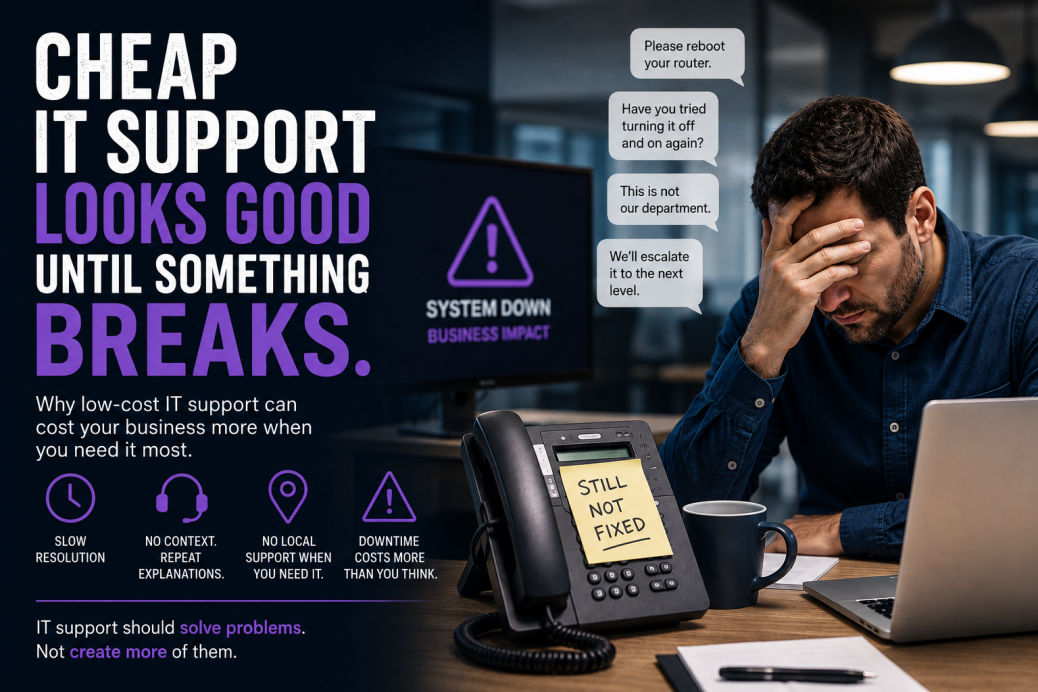
For many small and midsize businesses, cost pressure is constant. Leadership teams are being asked to do more with less, reduce overhead, and make smarter operational decisions without slowing growth. In that environment, outsourced IT support providers with aggressively low monthly pricing can seem like an obvious win.
The sales pitch is familiar. Unlimited support. 24/7 coverage. Fast response times. Enterprise-level expertise at a fraction of the cost of hiring internal IT staff.
For a business owner or operations leader trying to control expenses, that sounds like exactly the right answer.
And in some cases, the relationship may even feel fine at first. Basic issues get handled. Users submit tickets. Passwords get reset. Software gets installed. New employees get onboarded. The monthly bill stays predictable.
The problem is that IT support is one of those services that is easy to evaluate when things are calm and much harder to judge when your business is under pressure. The real test of your IT partner is not how they handle routine maintenance. It is how they respond when a server goes down, email stops working, ransomware hits, internet connectivity fails, or a critical employee cannot access the systems they need to do their job.
That is when the difference between inexpensive IT support and genuinely effective IT support becomes very clear.
Fast Responses Are Not the Same as Real Solutions
One of the most common selling points among low-cost IT providers is rapid response time. On the surface, this seems like a meaningful metric. If a support company responds within minutes, that sounds reassuring.
But response time and resolution quality are not the same thing.
Many low-cost support models are built around ticket throughput. Their goal is to acknowledge requests quickly, move issues through structured workflows, and maintain service-level metrics that look impressive in reports. That can create the appearance of efficiency while actual problems remain unresolved.
A user may receive a response in five minutes that says the issue has been received and assigned. Another update might arrive thirty minutes later asking for screenshots. Then the issue gets escalated to another technician. Then another queue. Hours pass, and little meaningful progress is made.
For simple requests, this may not matter much. A locked account or software installation is straightforward.
But when the issue involves multiple systems, business-critical infrastructure, or a problem that requires real troubleshooting experience, quick ticket acknowledgments do not help much.
If your firewall begins dropping traffic unexpectedly, if Microsoft 365 mail flow fails, if your VoIP phones go offline, or if your office loses access to shared files, your business does not need fast email replies. It needs someone capable of diagnosing the issue and taking ownership of solving it.
That distinction becomes very important during real operational disruptions.
When Nobody Knows Your Business, Everything Takes Longer
A major weakness of many budget IT support providers is the lack of continuity.
Businesses often assume their IT provider will become familiar with their systems, infrastructure, and workflows over time. In reality, many low-cost support operations rely on rotating technicians working from generalized documentation, if documentation exists at all.
That means every interaction can feel like starting over.
The technician assisting your team may have no working knowledge of your office network, your firewall configuration, your line-of-business software, your ISP setup, your Microsoft environment, or the history of previous incidents.
As a result, your employees repeatedly answer the same basic questions.
What changed?
When did this start?
Who manages your internet?
What firewall do you use?
Has anyone rebooted the equipment?
Do you know who handles DNS?
This is frustrating during small support requests, but it becomes expensive during outages.
When systems are down, every minute spent explaining your environment is a minute not spent fixing the problem. Institutional familiarity matters. A provider that already understands your environment can skip discovery steps, identify likely causes faster, and escalate more intelligently.
Businesses often underestimate how valuable operational familiarity becomes until they are in the middle of a crisis.
Remote-Only Support Has Real Limits
Remote support is an essential part of modern IT services. Many problems can and should be resolved remotely. Software issues, permissions problems, user account management, cloud administration, and many troubleshooting tasks can be handled efficiently without requiring an on-site visit.
But not everything can.
Physical infrastructure still matters for most businesses.
Network switches fail. Internet handoff equipment loses sync. Cabling degrades. Servers require physical intervention. Wireless access points malfunction. Workstations experience hardware failures. Printers create chaos in ways that somehow continue to defy logic.
In these moments, remote support reaches its limit.
A remote technician cannot reseat failed hardware, swap networking equipment, inspect physical cabling, coordinate directly with building infrastructure, or rapidly appear on-site during an emergency.
For businesses relying entirely on distant support teams, this often creates dangerous delays.
Instead of immediate action, teams are left troubleshooting equipment themselves, waiting for third-party dispatch, or improvising temporary workarounds while productivity stalls.
Businesses with offices, local infrastructure, or operational dependency on physical technology often discover that purely remote support creates gaps they did not anticipate when signing the contract.
Vendor Finger-Pointing Becomes Your Problem
Modern business technology rarely exists within a single vendor ecosystem.
A single outage might involve your ISP, firewall vendor, Microsoft 365 environment, DNS hosting provider, VoIP platform, endpoint security software, and line-of-business applications.
When technology fails, someone needs to coordinate the moving parts.
Low-cost support providers frequently operate with tightly constrained scopes of responsibility. If the issue touches something technically outside their ownership, escalation often stops.
That creates a familiar and frustrating pattern.
The ISP says it is not their problem.
Your cloud vendor says networking looks fine.
Your software vendor says the issue appears infrastructure-related.
Your IT provider says another vendor needs to investigate first.
Meanwhile, your internal staff become involuntary project managers trying to connect multiple companies that all want to avoid responsibility.
This is not just inefficient. It significantly extends downtime.
Strong IT partners understand that businesses do not care whose technical domain the issue belongs to. They care about restoring operations.
A capable provider takes ownership, manages escalation paths, coordinates vendors, and keeps the problem moving until resolution.
That level of accountability is often missing from bargain support relationships.
Security Gets Treated Like a Checkbox
Cybersecurity is one of the areas where low-cost IT support can create the greatest hidden risk.
Many inexpensive providers advertise security coverage because they include antivirus software, endpoint monitoring, patching, or firewall management. On paper, this can look comprehensive.
But having security products in place is not the same as having an effective security strategy.
The difference is implementation quality, monitoring discipline, policy design, and ongoing oversight.
Weak multi-factor authentication enforcement, stale user permissions, inactive employee accounts, incomplete backup verification, inconsistent patch management, poorly configured endpoint policies, and firewall misconfigurations are extremely common in under-managed environments.
Businesses may assume they are protected simply because software has been deployed.
In reality, meaningful cybersecurity requires active management.
Threats continue to evolve. Configurations drift over time. Staff changes create access sprawl. New software introduces new attack surfaces.
Security is not something that gets installed once and forgotten.
Low-cost providers often optimize for keeping service delivery affordable, which can leave little room for deeper security governance.
That becomes a serious problem the moment something goes wrong.
Strategic IT Is Usually Missing Entirely
One of the biggest misconceptions about outsourced IT support is that technical support automatically equals IT leadership.
They are not the same thing.
Many low-cost providers function as reactive help desks. If something breaks, they respond. If a user submits a request, they handle it.
But businesses need far more than ticket resolution.
Technology decisions affect budgeting, security, operations, compliance, scalability, vendor management, disaster recovery, and long-term infrastructure planning.
Without strategic oversight, environments tend to degrade slowly.
Hardware remains in service long after replacement makes sense.
Licensing costs expand without oversight.
Backup strategies fail to evolve.
Cloud environments become inconsistent.
Documentation becomes fragmented or nonexistent.
Technical debt accumulates quietly until it turns into a major disruption or expensive modernization project.
Strategic IT support means helping businesses plan, not just react.
That distinction often separates strong managed IT relationships from transactional support vendors.
The Lowest Monthly Price Can Become the Highest Total Cost
Businesses naturally compare vendor pricing. That is rational.
But monthly service cost is only one part of the financial picture.
The larger question is total operational cost.
What is the cost of a full day of downtime?
What does recurring productivity loss cost when unresolved technical issues slow your staff every week?
How much management time gets consumed coordinating vendors and troubleshooting escalations?
What is the financial exposure from weak cybersecurity governance?
What happens if neglected infrastructure fails unexpectedly?
A provider that costs less each month may create significantly higher downstream costs through inefficiency, downtime, risk, and poor planning.
That cheaper invoice can become one of the most expensive business decisions you make.
Why Local IT Support Still Matters
Technology has become increasingly cloud-based, remote, and decentralized.
That does not mean accountability should disappear.
Businesses still benefit enormously from working with IT partners who understand their environment, know their operational priorities, and can provide real support when remote troubleshooting is not enough.
Local support creates responsiveness that goes beyond ticket systems.
It creates familiarity.
It creates accountability.
It creates strategic relationships instead of transactional service interactions.
When a critical issue happens, businesses should not feel like anonymous ticket numbers waiting in a queue.
At Affant, we believe IT support should feel like having an actual technology department aligned with your business, not an outsourced help desk that only appears when something breaks.
Because cheap IT support often looks like a smart cost-saving move.
Until the day you need it most.